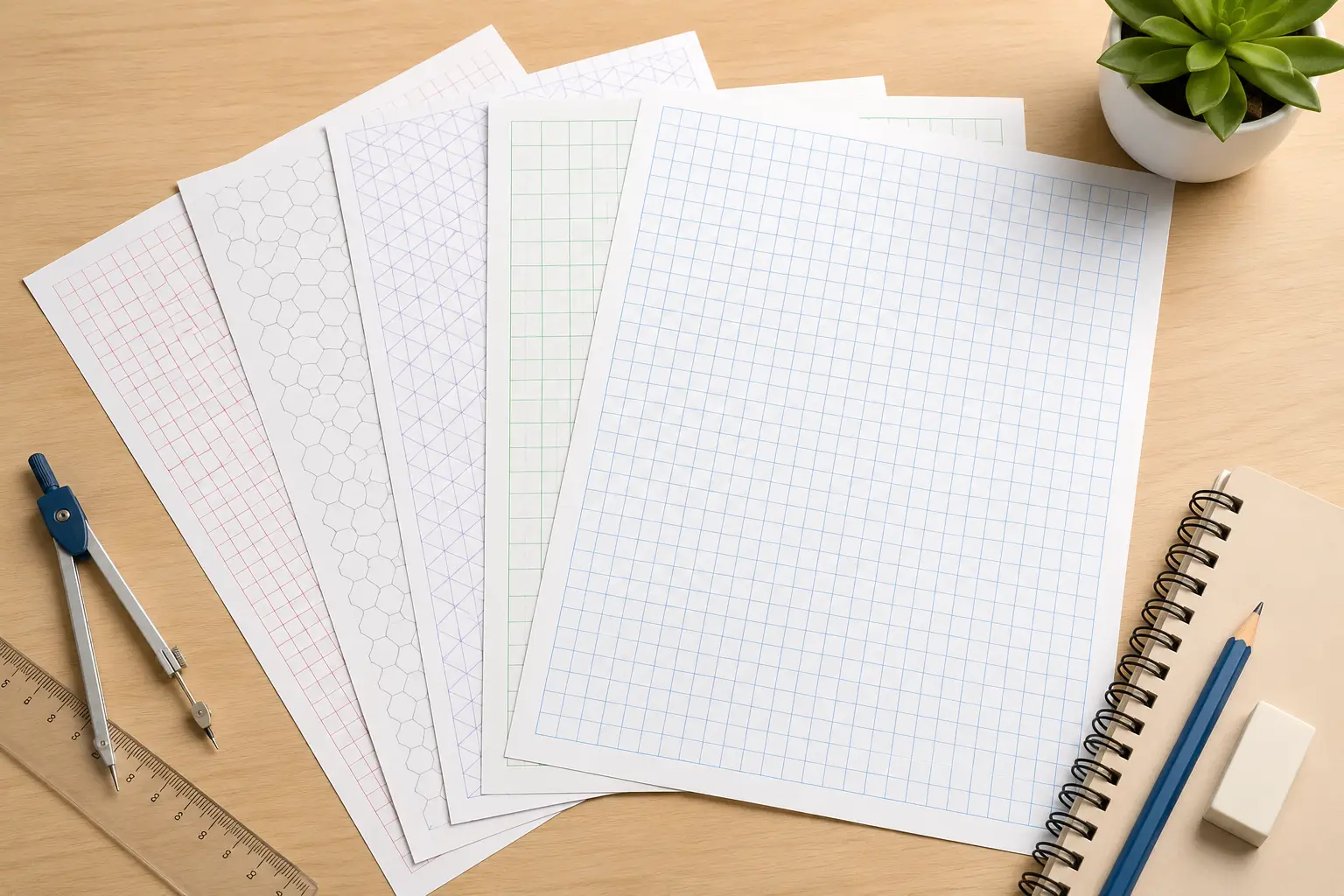
Graph paper—also known as grid paper, coordinate paper, or squared paper—is one of the most versatile tools in education, design, engineering, and daily planning. Whether you are a student solving geometry problems, an architect drafting initial structural layouts, a video game developer mapping 2D pixel levels, or a crafting enthusiast plotting intricate cross-stitch patterns, having access to the right grid layout is essential.
However, running to an office supply store every time you need a specific grid size or specialized layout is inefficient and costly. Buying entire pads of paper for a single project often leads to wasted sheets and extra clutter.
In 2026, high-resolution printable graph paper templates have solved this problem entirely. With a standard home printer, you can instantly generate custom, precision-lined grid sheets in standard Imperial or Metric measurements, specialized isometric angles, logarithmic scales, and polar coordinate formats.
In this ultimate guide, we explore every type of graph paper template available, break down their exact real-world uses, provide printing optimization tips to guarantee perfect scale accuracy, and explain how to choose the right template for your specific project.
⚡ Quick Summary: Common Graph Paper Types at a Glance
- Standard Square Grid (Quad Paper): Best for general math, algebra, bullet journaling, and basic floor plans.
- Isometric Graph Paper: Best for 3D sketching, architectural drafting, woodworking plans, and game design.
- Polar Coordinate Paper: Best for trigonometry, navigation, physics, and radial pattern design.
- Engineering / Engineering Pad Grid: Best for technical calculations, physics labs, and structural blueprints.
- Logarithmic & Semi-Log Paper: Best for scientific data analysis, exponential growth tracking, and financial modeling.
- Dot Grid Paper: Best for bullet journaling, calligraphy practice, UI/UX wireframing, and flexible sketching.
The Advantages of Using Printable Graph Paper Templates
While digital drawing tablets and CAD software are dominant in modern professional workflows, physical paper remains unmatched for rapid ideation, spatial learning, and hands-on planning. Printable graph paper templates combine the tactile benefits of physical paper with the flexibility of digital customization.
Here are the primary benefits of relying on digital, printable graph paper templates:
- Zero Cost and On-Demand Availability: Print only the exact number of pages you need, when you need them, eliminating the need to buy specialized notebooks.
- Customizable Line Weights & Colors: Commercial graph paper often features dark, heavy lines that distract from your work. Printable templates allow you to choose soft light grey, cyan, or pastel grid lines that keep your notes and drawings at the forefront.
- Exact Dimensional Precision: Standardized printable PDFs maintain precise physical measurements (such as 1/4 inch, 1/2 inch, or 1 millimeter grids) when printed at 100% scale.
- Eco-Friendly & Minimalist: Avoid unused pages sitting in binder drawers. Print single sheets or double-sided layouts to minimize paper waste.
Comparison Table: Graph Paper Types and Their Ideal Applications
| Grid Template Type | Standard Sizes / Spacing | Primary Industries / Use Cases | Key Visual Feature |
|---|---|---|---|
| Standard Quad Paper | 1/4″ (4×4), 1/2″ (2×2), 5mm metric | Elementary math, algebra, general graphing, note-taking | Equal horizontal and vertical square lines forming 90° intersections. |
| Isometric Grid | 1/4″, 1/2″, or 10mm equilateral triangles | 3D design, woodworking, piping diagrams, game mapping | Grid lines angled at 30°, 60°, and 90° to create 3D spatial depth without perspective distortion. |
| Dot Grid | 5mm dot spacing | Bullet journaling, UX/UI wireframing, calligraphy, ideation | Subtle dots placed at grid intersections instead of continuous printed lines. |
| Engineering Grid | 5×5 per inch or 10×10 per inch with heavy major lines | Civil engineering, physics labs, drafting, calculus | Unprinted margin header with distinct light minor lines and dark major unit lines. |
| Polar Coordinate Grid | Concentric circles spaced radially (e.g., 10° to 30° increments) | Trigonometry, circular design, radar tracking, navigation | Concentric circles expanding from a central origin point intersected by radial degree lines. |
| Logarithmic & Semi-Log | 1-cycle, 2-cycle, or 3-cycle log scales | Data science, financial trends, chemistry rate laws, acoustic engineering | Unequally spaced grid lines scaled non-linearly to plot exponential growth or wide value ranges. |
Deep Dive: Choosing the Right Graph Paper Template
Selecting the correct graph paper style is crucial to ensuring your drawing, calculation, or design layout turns out accurately. Below is a detailed analysis of the most popular graph paper varieties available for free download.
1. Standard Quad Graph Paper (Square Grid)
Quad paper (short for quadrille paper) is the classic square grid used in classrooms and offices around the world. It features perpendicular horizontal and vertical lines that form uniform square cells.
Common Grid Specifications:
- 4×4 Grid (4 squares per inch / 0.25-inch spacing): The standard size for high school and college algebra, calculus, and introductory statistics.
- 5×5 Grid (5 squares per inch / 0.20-inch spacing): Commonly required for science courses, lab work, and precise data plotting.
- 1-Centimeter Metric Grid: Widely used in metric-based educational systems and primary school spatial learning activities.
Best For: Plotting X/Y coordinate graphs, practicing handwriting alignment, basic room layouts, and organizing math equations.
2. Isometric Graph Paper (3D Triangular Grid)
Isometric graph paper features a grid of equilateral triangles formed by vertical lines and diagonal lines angled at 30 degrees to the horizontal baseline. Unlike perspective drawing, isometric projection maintains consistent scale measurements across all three axes (X, Y, and Z).
Why Designers Love Isometric Templates:
- No Perspective Distortion: Parallel lines remain parallel, allowing you to measure dimensions directly off the paper regardless of depth.
- Rapid Architectural & Woodworking Mockups: Perfect for sketching custom furniture, cabinetry, deck extensions, or interior room volumes.
- Pixel Art & Game Level Planning: Essential for retro video game developers designing isometric tilemaps and world geometry.
Best For: Woodworkers, architects, mechanical design students, industrial designers, and game developers.
3. Dot Grid Paper
Dot grid paper replaces solid continuous lines with small, unobtrusive dots placed at regular intervals (typically 5mm apart). This provides the structural organization of a traditional grid without creating visual noise on the page.
Key Marketing & Productivity Uses:
- Bullet Journaling (Bujo): Allows users to draw custom habit trackers, daily planners, and weekly logs cleanly without bright lines cluttering the artwork.
- UX/UI Wireframing: Web designers and mobile app developers use dot grid templates to rapidly sketch user interface layouts, button placements, and app screens.
- Hand Lettering & Calligraphy: Provides invisible guidelines that help typographers maintain uniform letter height, baseline consistency, and slant angles.
Best For: Planners, journalers, UI/UX designers, typographers, and casual illustrators.
4. Engineering Grid Paper (Engineering Pad Style)
Professional engineering pads traditionally feature light green or cyan grid lines printed on the back of thin translucent paper so the grid bleeds through softly to the front. Digital engineering graph paper templates replicate this classic layout digitally.
Distinct Characteristics:
- Major vs. Minor Grid Lines: Grid boxes are divided into small 10×10 or 5×5 sub-grids, with darker major lines marking full inch increments for quick visual scaling.
- Blank Header Block: Includes a dedicated top margin for project titles, engineer names, dates, course codes, and page counts.
- High Contrast & Clean Scans: Designed so pencil markings stand out sharply, making sheets easy to digitize or photocopy cleanly.
Best For: Civil, structural, and mechanical engineering students, physics labs, and professional technical calculations.
5. Polar Coordinate Graph Paper
Polar graph paper consists of concentric circles expanding outward from a single central pole point, intersected by radial lines radiating outward at measured angle increments (usually 5°, 10°, or 15° intervals).
Primary Technical Applications:
- Trigonometric & Calculus Plotting: Plotting complex equations defined by radius ($r$) and angle ($\theta$) coordinates rather than traditional Cartesian ($x, y$) coordinates.
- Navigation & Antenna Radiation Patterns: Used in marine navigation, aviation routing, and wireless communications to plot directional radio signal strength.
- Circular Patterns & Mandalas: Used by artists and craftspeople to draft symmetrical circular patterns, geometric mandalas, and stained glass window designs.
Best For: Advanced math students, electrical engineers, navigators, and radial pattern craft artists.
6. Logarithmic and Semi-Logarithmic Graph Paper
Logarithmic paper features grid lines scaled according to logarithmic mathematical functions rather than uniform linear increments. This compresses huge ranges of numerical values into a manageable paper space.
Understanding Log Scale Variations:
- Semi-Log Paper: Features one linear axis (standard equal spacing) and one logarithmic axis. Ideal for plotting data that grows exponentially over time (such as compound interest or bacterial growth).
- Full Log-Log Paper: Features logarithmic scaling on both horizontal and vertical axes. Used when plotting power-law relationships between two variables.
- 1-Cycle, 2-Cycle, and 3-Cycle Options: The number of “cycles” determines how many orders of magnitude (e.g., 1–10, 10–100, 100–1,000) can fit on a single page.
Best For: Economists, data analysts, acoustic engineers, chemists, and financial researchers.
7. Specialized Crafting & Needlework Graph Paper
Not all graph paper uses square cells. Specialized crafting templates alter the aspect ratio of the grid cells to match specific physical materials.
- Knitting Graph Paper: Knit stitches are wider than they are tall (typically a 4:5 or 2:3 aspect ratio). Knitting graph paper uses rectangular cells so design patterns reflect their actual knitted appearance.
- Cross-Stitch Grid Paper: Uses bold 10×10 cell blocks with centered cross markers to help embroiderers translate digital images into thread patterns.
- Beading Graph Paper (Peyote & Brick Stitch): Features offset hexagonal or staggered grid patterns designed specifically for seed bead weaving.
How to Print Graph Paper PDF Templates with 100% Dimensional Accuracy
A common issue when printing graph paper at home is that the printed grid boxes end up slightly smaller or larger than advertised (for example, a 1/4-inch square printing out at 0.22 inches). This occurs because printer drivers often auto-scale documents to fit page margins.
To ensure your printed graph paper templates match physical ruler measurements perfectly, follow these step-by-step printer configuration rules:
🖨️ Step-by-Step Printer Calibration Guide
- Download the PDF Directly: Always save the graph paper PDF template to your desktop or device first rather than printing directly from an internet browser preview window.
- Open in a Dedicated PDF Reader: Open the file using official PDF software such as Adobe Acrobat Reader or Preview.
- Locate Page Scaling Settings: In the Print Dialog menu, look for “Page Sizing & Handling.”
- Select “Actual Size” or Set Scale to 100%: Never select “Fit to Page,” “Shrink Oversized Pages,” or “Scale to Fit.” Selecting these options alters the exact dimensions of the grid.
- Verify Paper Size Settings: Ensure your printer paper selection matches your file template size exactly (e.g., US Letter 8.5″ x 11″ or A4 210mm x 297mm).
- Perform a Ruler Test: After printing your first page, place a physical ruler against the grid lines to confirm that 1 inch or 1 centimeter matches the ruler perfectly before mass printing.
Selecting the Right Paper Stock and Ink Settings for Your Project
To maximize the functionality of your printable graph paper templates, match your paper type and printer settings to your intended use case:
1. Choosing the Ideal Paper Weight
- Standard 20 lb Copy Paper: Perfect for temporary math scratch paper, quick classroom worksheets, and disposable daily planning notes.
- 24 lb to 28 lb Premium Bond Paper: Highly recommended for engineering homework, technical drafting, and fountain pen writing. Higher opacity prevents ink feathering and show-through.
- 65 lb Cardstock: Ideal for architectural model building, isometric cutting guides, custom board game prototype cards, and durable craft templates.
2. Optimizing Grid Line Color for Visual Comfort
Dark black grid lines can make handwritten pencil notes difficult to read and create harsh backgrounds for scanned documents. When customizing your printable templates, select one of these recommended grid line colors:
- Light Cyan / Non-Photo Blue: Traditionally used in comic illustration and graphic design because blue ink lines can be automatically filtered out by digital scanners.
- Soft Neutral Grey (30% to 40% Opacity): The single best color for general note-taking, bullet journaling, and math work. Keeps your handwriting prominent while providing structured guidance.
- Mint Green / Pale Teal: Reduces eye strain during long technical calculation sessions, mimicking classic professional engineering pads.
Creative and Non-Traditional Uses for Graph Paper Templates
Graph paper is not limited to math classrooms and technical engineering offices. Creative professionals and hobbyists utilize grid templates in various innovative ways:
1. DIY Home Floor Planning & Furniture Arranging
Before moving heavy furniture or starting a renovation, print a 1/4-inch quad grid sheet. Establish a simple scale where 1 grid square equals 1 square foot. Measure your room dimensions, sketch the outer walls, and cut out scaled paper shapes representing your sofa, bed, desks, and tables to test room arrangements without heavy lifting.
2. Pixel Art and Sprite Design
Digital artists and indie game developers use high-density quad paper (such as 10×10 or 20×20 grids per inch) to plan pixel art characters, icon sets, and tileable environment textures by coloring individual grid cells with colored pencils or markers.
3. Landscape and Garden Bed Layouts
Gardening enthusiasts use 1-centimeter or 1/4-inch grid templates to organize raised garden beds, space out vegetable plantings according to square-foot gardening principles, and map seasonal crop rotations.
4. Maze Generation and Tabletop RPG Map Making
Dungeon Masters running tabletop roleplaying games (like Dungeons & Dragons) rely heavily on 1-inch and 1/2-inch square or hex grid paper sheets to quickly draw battle maps, dungeon corridors, terrain obstacles, and castle floor plans for game miniatures.
Frequently Asked Questions (FAQs)
What is the difference between quad paper and engineering paper?
Standard quad paper features uniform grid lines across the entire sheet without margin breaks. Engineering paper usually features a top title header block, distinct major grid lines every inch, lighter minor grid lines inside each inch block, and unprinted margin borders.
What grid size is best for bullet journaling?
A 5mm dot grid layout on US Letter or A5 paper is the universal standard for bullet journaling. The 5mm spacing offers the perfect balance for handwriting alignment, drawing weekly calendar columns, and organizing daily task lists cleanly.
Why did my graph paper template print out at the wrong scale?
Your printer software likely altered the scale automatically using a “Fit to Printable Area” or “Shrink to Fit” setting. To fix this, reopen your PDF print dialog box and explicitly select “Actual Size” or set the scaling percentage to 100%.
Can I print graph paper on standard A4 or US Letter paper?
Yes. Printable graph paper PDF templates are formatted specifically for standard paper dimensions, including US Letter (8.5 x 11 inches), Legal (8.5 x 14 inches), and international A4 (210 x 297 mm) paper sizes.
What is isometric graph paper used for?
Isometric graph paper uses 30-degree angled grid lines to allow artists, engineers, and woodworkers to draw three-dimensional objects accurately on a two-dimensional flat sheet of paper without perspective distortion.
Conclusion
Having instant access to free, high-quality printable graph paper templates empowers students, educators, engineers, artists, and DIY hobbyists to tackle any technical or creative project without buying expensive specialty notebooks.
By understanding the distinct advantages of each grid layout—from standard quad paper and 3D isometric templates to dot grids and polar coordinate sheets—you can choose the exact format that best suits your needs.
Remember to set your printer settings to 100% Actual Size, select comfortable light grey or soft cyan line colors, and pair your templates with quality paper stock to enjoy high-precision, professional grid paper right from your home printer.