Managing a project in today’s fast-paced digital world feels like juggling flaming torches while riding a unicycle. Between tracking deadlines, managing team capacity, controlling budgets, and keeping stakeholders happy, project managers (PMs) often spend more time putting out fires and updating spreadsheets than actually driving strategic growth.
Enter Artificial Intelligence (AI).
From predictive analytics to smart task assignment, AI has moved from a futuristic buzzword to a daily operational necessity. But the big question remains: Is AI truly helpful for project management, or is it just another overhyped tech trend?
In this comprehensive, deep-dive guide, we will break down how AI is changing project management, real-world use cases, top tools to use in 2026, potential risks, and whether AI will ever replace human project managers.
How AI Is Transforming Modern Project Management (Real-World Impact)
To understand the value of AI, we first need to look at where project managers spend most of their energy. Historically, up to 50% of a PM’s workday goes toward non-strategic administrative labor—chasing status updates, writing meeting minutes, adjusting Gantt charts, and calculating budget variances.
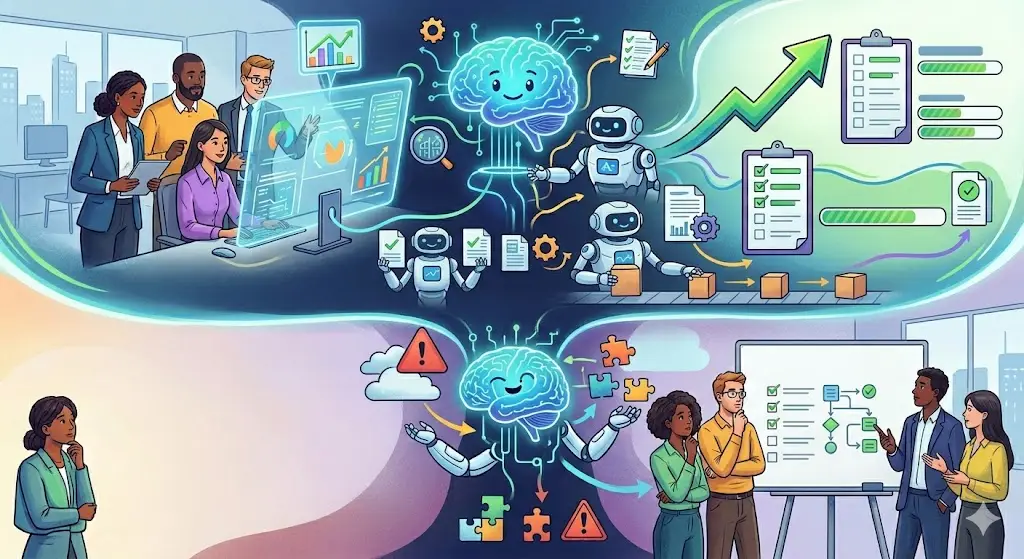
AI transforms this dynamic by shifting the project manager’s role from reactive tracking to proactive leadership. Here are the primary areas where AI delivers measurable impact:
1. Predictive Analytics and Risk Forecasting
Traditional risk management relies heavily on historical hindsight and human intuition. You realize a deadline is in danger only after a team member misses a critical milestone.
AI-driven predictive models analyze historical project performance, team velocity, dependency chains, and real-world variables to predict delays before they occur. For instance, if an engineering team historically takes 30% longer to complete security compliance tasks, an AI system flags this bottleneck during the planning phase and automatically adjusts the baseline schedule.
2. Automated Task Scheduling and Resource Allocation
Overbooking team members leads to burnout, while underutilizing resources wastes capital. Manual resource allocation requires constant calibration across multiple calendars and skill sets.
Smart AI algorithms evaluate individual team members’ skill levels, current workloads, time-off schedules, and historical delivery speed. The system then automatically suggests optimal task assignments, preventing overallocation while ensuring high-priority tasks land with the right team members.
3. Real-Time Status Tracking and Intelligent Reporting
Writing weekly status reports for executives consumes hours of manual work. AI tools aggregate progress updates, code commits, task completion rates, and budget consumption in real-time.
Instead of manually compiling data into slide decks, PMs can generate instant natural-language summaries tailored for different audiences—high-level strategic insights for CEOs, or detailed technical breakdowns for team leads.
4. Automated Meeting Summaries and Action Item Extraction
How many meetings end with ambiguous action items and forgotten agreements? AI-powered meeting assistants (such as Otter.ai or Fireflies) join calls, transcribe conversations, categorize key discussions, and extract actionable tasks directly into your project board (e.g., Jira or Asana) without human intervention.
5. Budget Optimization and Cost Overrun Prevention
According to PMI (Project Management Institute) reports, budget overruns remain one of the leading causes of project failure. AI algorithms monitor spending rates against work completed (Earned Value Management) and alert managers to cost anomalies early enough to adjust scope before budgets are blown.
Top AI Tools for Project Managers in 2026
If you are looking to integrate AI into your workflow, several industry-standard project management platforms have built powerful AI engines into their core features:
| Tool | Key AI Feature | Best For | Ideal Team Size |
|---|---|---|---|
| ClickUp AI | Role-specific prompts, instant task creation from chat, automated summaries | All-in-one productivity and cross-functional teams | Small to Enterprise |
| Asana Intelligence | Smart goal setting, risk detection, and natural language query workflow building | Agile workflows and goal tracking (OKRs) | Medium to Enterprise |
| Monday.com AI | Automated column generation, formula builders, and task extraction | Visual project tracking and marketing operations | Small to Large |
| Jira AI (Atlassian Intelligence) | Automated issue drafting, JQL query generation, and incident response routing | Software development and DevOps teams | Technical Teams |
| Notion AI | Q&A across workspace docs, project spec drafting, and automatic database tagging | Knowledge management and creative project planning | Startups & Agencies |
Key Benefits: Why Organizations Are Adopting AI in Project Management
Implementing AI tools isn’t just about using fancy technology; it delivers tangible operational results. Here are the core benefits organizations reap when leveraging AI:
- Dramatically Reduced Administrative Overhead: PMs spend less time on routine data entry and schedule updates, freeing up bandwidth for strategic planning and stakeholder management.
- Higher Decision Accuracy: Decisions grounded in machine learning data analysis reduce reliance on subjective guesswork or cognitive biases.
- Faster Time-to-Market: Bottlenecks are identified and cleared early in the pipeline, allowing product teams to ship features faster.
- Improved Team Retention: By automating tedious work, team members can focus on high-value creative and technical problem-solving, increasing overall job satisfaction.
- Clearer Stakeholder Communication: Instant, objective reporting minimizes scope misunderstandings between development teams and executive leadership.
The Limitations and Risks of AI in Project Management
While AI provides massive efficiencies, relying blindly on artificial intelligence introduces critical risks. A human-in-the-loop approach remains essential due to the following factors:
1. Lack of Human Empathy and Emotional Intelligence (EQ)
Project management is ultimately about people. AI cannot resolve interpersonal team conflicts, understand personal crisis situations, motivate an exhausted engineer, or negotiate delicately with an angry client. EI (Emotional Intelligence) remains an exclusively human skill set.
2. Data Privacy and Security Concerns
Feeding proprietary project details, codebase blueprints, financial budgets, or client data into unvetted public AI models poses major cybersecurity threats. Companies must enforce strict data governance policies and enterprise-grade security protocols before granting AI access to sensitive workspaces.
3. Garbage In, Garbage Out (Data Quality Dependency)
AI models rely entirely on the quality of historical data. If your team historically logged inaccurate work hours, skipped task status updates, or mislabeled project risks, the AI’s predictions will be inherently flawed and misleading.
4. Algorithmic Bias and Hallucinations
Generative AI models are prone to hallucinating facts or misinterpreting complex contextual nuances. An over-reliance on AI-generated estimates without human review can lead to wildly unrealistic commitments.
Pro Tip for PMs: Treat AI outputs as a “drafting co-pilot” rather than an absolute authority. Always validate AI suggestions against real-world contextual factors that algorithms cannot see.
Will AI Replace Project Managers? (The Truth)
The short answer is No—AI will not replace Project Managers, but Project Managers using AI will replace those who don’t.
Project management consists of two distinct dimensions:
- The Science of PM: Scheduling, budget tracking, resource reporting, risk quantification, and documentation. (AI excels here).
- The Art of PM: Leadership, negotiation, stakeholder alignment, ethical decision-making, conflict resolution, and creative problem-solving. (Humans excel here).
As AI takes over the “science” side of project management, human PMs will transition into strategic leaders, innovation facilitators, and organizational relationship builders. The demand for project managers won’t decline; rather, the skill profile required for the job will evolve.
How to Implement AI in Your Project Management Workflow (Step-by-Step)
If you want to introduce AI into your existing team workflow without overwhelming everyone, follow this pragmatic roadmap:
Step 1: Start with Low-Risk Administrative Automation
Do not attempt to overhaul your entire portfolio management overnight. Begin by introducing AI meeting summarizers (like Otter.ai) or draft status report generators. Measure how much time you save on documentation first.
Step 2: Clean and Standardize Your Historical Data
Before enabling predictive AI tools in systems like Jira or Asana, clean up your team’s project boards. Establish standard naming conventions, enforce regular time-logging, and archive abandoned tasks so the AI trains on clean metrics.
Step 3: Train Your Team on Prompt Engineering and AI Tools
Help team members write effective prompts for project documentation, user story creation, and task decomposition. Provide clear guidelines on what proprietary data can and cannot be entered into AI prompts.
Step 4: Establish a Human-in-the-Loop Validation System
Enforce a strict policy where all AI-suggested schedules, cost forecasts, and resource allocations are reviewed and approved by a human project lead before implementation.
Frequently Asked Questions (FAQs)
Is AI expensive to implement in project management?
Not necessarily. Most major project management tools (ClickUp, Asana, Monday, Notion) include AI capabilities within their existing mid-tier subscription plans for a small add-on fee ($5 to $10 per user/month). The productivity hours saved typically outweigh the license costs rapidly.
Can AI handle Agile and Scrum frameworks?
Yes, AI is exceptionally well-suited for Agile frameworks. It can assist in sprint planning by calculating historical team velocity, breaking epic user stories into sub-tasks, generating acceptance criteria, and flagging sprint scope creep in real-time.
What is the biggest mistake teams make when adopting AI for projects?
The biggest mistake is treating AI as an autonomous decision-maker rather than an assistant. Expecting AI to run projects independently without human oversight leads to misaligned expectations, security breaches, and team frustration.
Final Verdict: Is AI Helpful for Project Management?
Without a doubt, AI is highly helpful for project management. It acts as an invaluable operational multiplier, eliminating repetitive grunt work, predicting hidden delivery risks, and giving managers real-time visibility into project health.
However, AI is an amplifier of human capability—not a replacement for human judgment. The most successful organizations in 2026 and beyond will be those that pair smart AI automation with empathetic, strategic, human project leadership.
Are you using AI in your daily project management workflow? Which tools have made the biggest difference for your team? Share your thoughts in the comments below!