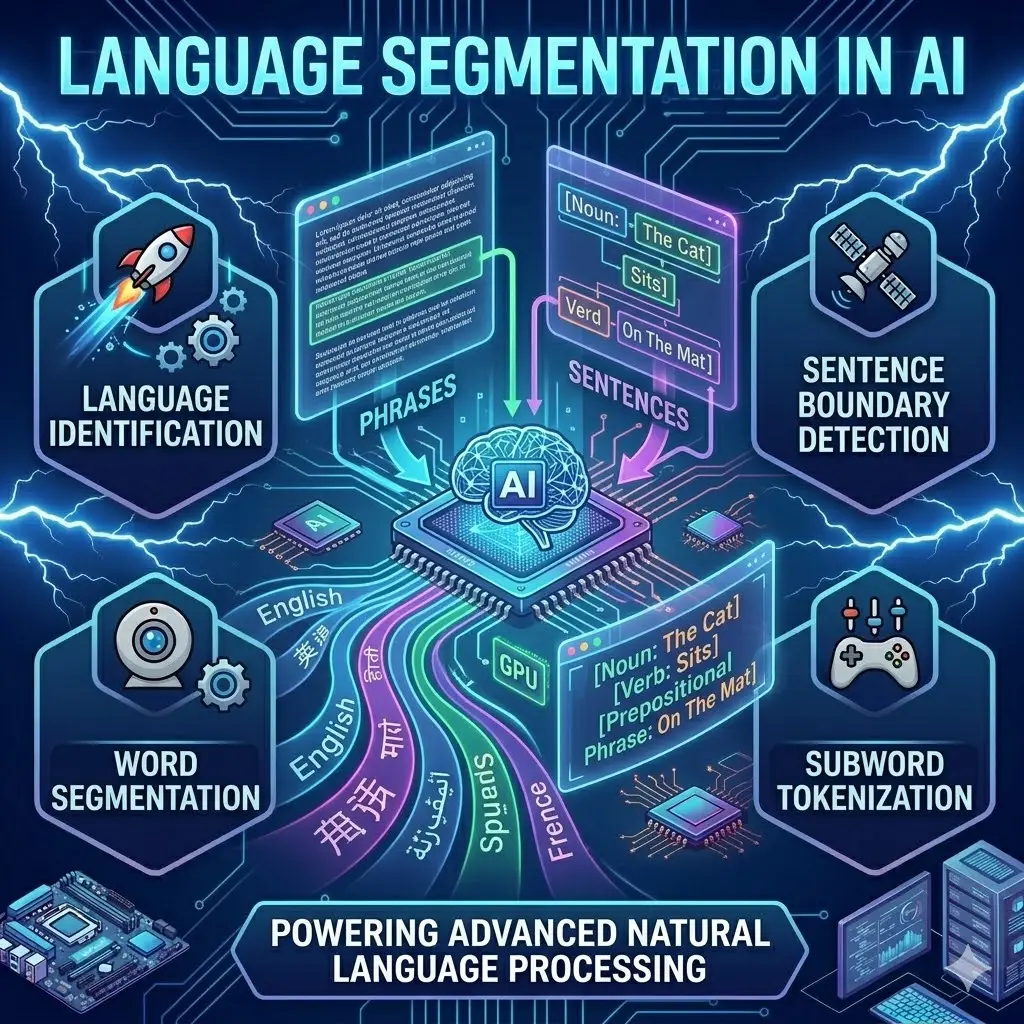
When humans read a sentence or hear someone speak, our brains instantly separate words, pause at periods, and recognize when a speaker shifts from one topic to another. We do this effortlessly without conscious thought.
For Artificial Intelligence, however, human language is just a chaotic, continuous sequence of characters, pixels, or audio frequencies. A machine doesn’t naturally know where one word ends, where a sentence stops, or when a paragraph changes subtopics.
This is where Language Segmentation in AI comes in.
Whether you are building Retrieval-Augmented Generation (RAG) pipelines, training LLMs like GPT-4 or Claude, developing real-time voice translators, or optimizing search engines, language segmentation is the non-negotiable step zero. In this detailed guide, we will demystify what language segmentation is, how it works across different AI models, its real-world use cases, and why it is critical for modern generative AI.
What is Language Segmentation in Artificial Intelligence?
At its simplest, Language Segmentation is an AI and Natural Language Processing (NLP) technique that divides continuous linguistic data (text or speech) into smaller, semantically distinct chunks called “segments.”
Depending on the problem the AI model is trying to solve, these segments can be at different granularities:
- Sub-word / Character level: Splitting words into root components or tokens (e.g., “unbreakable” → “un”, “break”, “able”).
- Word level: Isolating individual words, especially in languages without whitespace like Chinese, Japanese, or Thai.
- Sentence level: Identifying sentence boundaries despite ambiguous punctuation (e.g., distinguishing “Dr. Smith” from the end of a sentence).
- Topic / Semantic level: Dividing a 20-page document into distinct thematic sections (crucial for vector databases and RAG).
- Audio / Speech level: Segmenting spoken audio into individual words or separating different speakers in a conversation (Speaker Diarization).
Without accurate language segmentation, AI models suffer from severe context loss, hallucinate incorrect facts, misinterpret grammar, and burn through unnecessary computing power.
The 4 Main Types of Language Segmentation in AI
To truly grasp how modern AI systems process text and speech, it helps to break down language segmentation into its four distinct operational types:
1. Word and Subword Segmentation (Tokenization)
In Western languages like English or Spanish, spaces naturally mark word boundaries. But in languages like Chinese (Mandarin), Thai, or Vietnamese, words run together without spaces (e.g., Chinese: 我喜欢人工智能).
AI models use sophisticated word segmentation algorithms—such as Byte-Pair Encoding (BPE), WordPiece, or SentencePiece—to decide where individual word units begin and end. Modern Large Language Models rely on subword tokenization to efficiently handle rare words, misspellings, and prefixes/suffixes while keeping vocabulary sizes manageable.
2. Sentence Boundary Disambiguation (SBD)
It sounds simple: just split text wherever you see a period (.), question mark (?), or exclamation point (!). Right?
In real-world text, periods are notoriously ambiguous. Consider this sentence: “Dr. Miller paid $19.99 for the book at 5 p.m. on Main St.”
A simple rule-based split would break this single thought into six broken fragments. Machine learning models trained on Sentence Boundary Disambiguation analyze surrounding context, capitalization patterns, and part-of-speech tags to determine if a period actually marks the end of a sentence or just an abbreviation.
3. Semantic and Topic-Based Text Segmentation
When feeding long documents, research papers, or user manuals into AI vector databases for Retrieval-Augmented Generation (RAG), sending the entire 100-page PDF at once degrades performance. Conversely, chopping it every 500 arbitrary characters cuts sentences in half, ruining the meaning.
Semantic text segmentation (such as algorithms like TextTiling or LLM-based window sliding) analyzes the mathematical similarity between adjacent paragraphs. When the underlying topic shifts significantly, the AI places a “boundary score” and splits the document into coherent, self-contained subtopics.
4. Speech and Acoustic Audio Segmentation
Language isn’t just written—it is spoken. In Automatic Speech Recognition (ASR) systems (like Siri, Whisper, or Google Assistant), voice audio is a continuous sound wave full of background noise, pauses, and overlapping voices.
Audio language segmentation breaks speech signals down into silence intervals, phonemes, spoken words, and distinct speaker turns (known as Speaker Diarization). This ensures the AI transcribes “ice cream” vs. “I scream” correctly based on micro-pauses and vocal stress.
Comparison of Language Segmentation Approaches
Different tasks require different levels of segmentation granularity. Here is how they stack up side-by-side:
| Segmentation Level | Primary AI Technique | Key Challenge | Primary AI Application |
|---|---|---|---|
| Subword / Token | Byte-Pair Encoding (BPE), SentencePiece | Balancing vocabulary size vs. context window space | LLM Pretraining (GPT-4, Gemini, Llama) |
| Word-Level | MaxMatch, CRF, Deep Learning Embeddings | Asian & non-whitespace scripts, compound words | Machine Translation, Search Indexing |
| Sentence-Level | Contextual Rule Engines, spaCy, NLTK transformers | Ambiguous punctuation, abbreviations, informal chat text | Text Summarization, Grammar Checkers |
| Semantic / Topic | TextTiling, Cosine Similarity, Dense Embeddings | Determining precise topic boundaries without hardcoded rules | RAG Vector Search, Document Chunking |
| Speech / Audio | VAD (Voice Activity Detection), Neural Diarization | Background noise, overlapping speakers, regional accents | Automated Transcription, Voice Bots |
How Language Segmentation Actually Works (Step-by-Step)
To appreciate how AI processes input, let’s step through a complete text segmentation lifecycle from raw human input to AI understanding:
Step 1: Ingestion & Normalization
Raw text is fed into the system. The AI cleans up formatting, strips out hidden control characters, handles unicode variations, and standardizes spacing.
Step 2: Boundary Candidate Identification
The segmentation engine scans the stream using statistical probabilities or neural attention mechanisms to flag candidate split points (such as spaces, punctuation, topic shifts, or audio silences).
Step 3: Contextual Feature Analysis
Instead of making isolated guesses, modern neural networks look at surrounding context embeddings. The AI evaluates vectors before and after the candidate split to ask: “Does the mathematical meaning stay consistent across this boundary, or does it change?”
Step 4: Boundary Thresholding and Scoring
The model calculates a depth or probability score for each boundary. If the score crosses a specified confidence threshold (e.g., >85%), the boundary is accepted, and the text is partitioned.
Step 5: Token / Vector Conversion
Once segmented cleanly, each piece is assigned a unique numerical token ID or converted into a vector embedding, ready for processing by downstream AI algorithms.
Why Language Segmentation is Critical for Generative AI & RAG
If you are developing or implementing AI tools in 2026, understanding language segmentation is directly tied to model performance and cost efficiency:
1. Supercharging Retrieval-Augmented Generation (RAG)
In enterprise RAG pipelines, bad chunking leads to useless search results. If your text segmentation breaks a sentence containing a product warranty policy right down the middle, the vector database returns an incomplete answer to your customer service chatbot. Semantic topic segmentation ensures every retrieved chunk contains a complete, self-contained thought.
2. Optimizing LLM Context Windows & Memory
Large Language Models charge fees and consume RAM based on tokens. Efficient subword segmentation reduces token inflation—allowing you to pack more information into the model’s context window while reducing API costs by up to 20–30%.
3. Solving Multilingual and Code-Switching Challenges
Global users frequently mix languages in casual communication—such as “Hinglish” (Hindi + English) or “Spanglish”. High-quality AI language segmentation can dynamically identify language switches mid-sentence (e.g., “Aaj ka weather bohot amazing hai”) and route sub-segments to the appropriate translation or sentiment analysis engine.
Key Takeaway: High accuracy in downstream AI tasks (like summarization, translation, or QA) depends overwhelmingly on clean language segmentation at the start of the data pipeline.
Key Challenges in AI Language Segmentation
Despite massive advancements in transformer models, AI segmentation still faces tough real-world hurdles:
- Slang and Informal Social Media Text: Tweets, WhatsApp messages, and Reddit comments often omit punctuation, run words together (e.g., “gonna”, “wanna”, “idk”), and abuse emojis, confusing traditional segmenters.
- Noisy Audio Environments: Background chatter, wind noise, or low-quality phone microphones make audio speech segmentation difficult for AI transcription tools.
- Domain-Specific Jargon: Legal contracts, medical reports, and software code contain specialized formatting and abbreviations that break standard out-of-the-box sentence segmenters.
- Computational Overhead: Running deep transformer-based semantic segmenters on millions of documents requires significant GPU compute compared to simple rule-based splitters.
Frequently Asked Questions (FAQs)
What is the difference between tokenization and language segmentation?
Tokenization is a specific sub-type of language segmentation. Tokenization breaks text into small tokens (words, subwords, or characters) for model ingestion, whereas language segmentation is the broader discipline that includes dividing sentences, topics, document chapters, and audio streams.
Why is language segmentation hard for non-Western languages?
Languages like Chinese, Japanese, Thai, and Lao do not use spaces between words. AI models cannot rely on whitespace delimiters and must use statistical probability models or deep neural networks to infer word boundaries based on contextual meaning.
How does text segmentation affect vector databases?
Vector databases store text chunks as mathematical vectors. If text segmentation cuts off text randomly, the mathematical vector loses its core semantic meaning, making semantic search and RAG retrieval inaccurate.
Final Thoughts: The Unsung Hero of AI
Language segmentation rarely gets the glamorous headlines that image generators or autonomous agents receive, but it remains one of the fundamental pillars of Natural Language Processing.
As Large Language Models become more deeply integrated into enterprise workflows, smart, context-aware language segmentation will be the difference between an AI that truly understands human nuance and one that delivers broken, hallucinated results.
How are you handling text chunking or tokenization in your AI projects? Have you tried semantic segmentation for your RAG pipelines? Drop your comments and questions below!