Artificial intelligence interacts alongside human languages in numerous efficient methods, ranging from chatbots to translators to voice assistants as well as search engines. What lies behind these effortless interactions is an essential foundational procedure called segmentation of languages. This aids AI machines understand the point at which meaning is created and where it ends, either in speech or text.
If not properly segmented the language data is the continuous stream. AI models need to break this stream down into smaller, more relevant pieces in order to understand or analyse the data. Learning how the language segmentation process is done makes it simpler to understand how current AI machines read, listen and react with greater efficiency.
The reason why breaking language into units is important
Human language is naturally organized. Conversations are structured by words, sentences create concepts, and thoughts create conversations. But computers don’t automatically understand these distinctions.
Segmentation of language helps AI to organize inputs into manageable parts. After speech or text has been broken down into separate elements, AI models can assign significance, identify patterns, and complete tasks like summary, translation, and sentiment analysis, and answer questions.
In this case, a speech recognition software must determine where one word’s end while another word starts. Text analysis tools will need to determine the boundaries of a sentence before determining the subject or emotional that is behind the message.
Segmentation thus serves as the very first step of various language processing pipelines.
Understanding the Core Concept
Language segmentation refers to the act that divides language data into small segments which carry significance. They can differ depending upon the function of the AI machine.
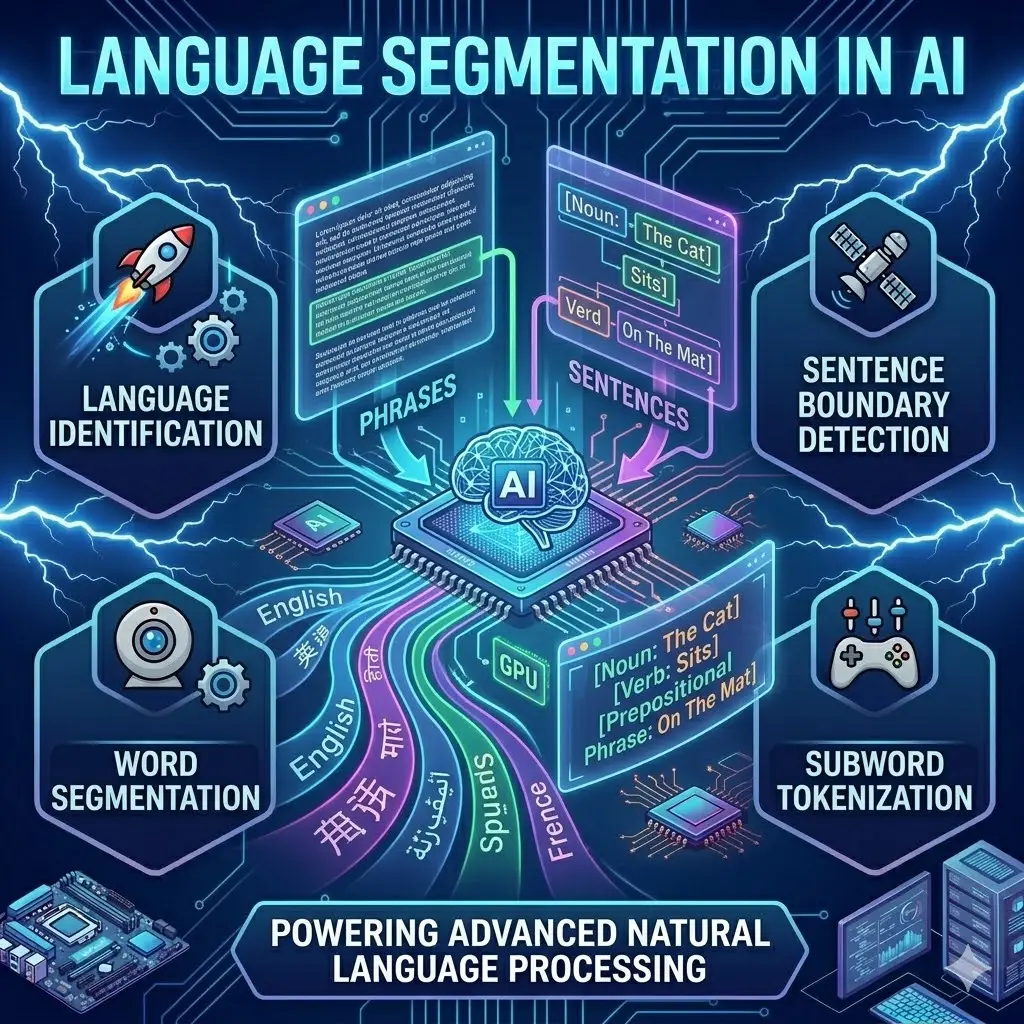
Common segmentation levels include:
- Word segmentation – separating continuous text into individual words
- Segmentation of sentences – delineating the beginning and the end of sentences
- Topic Segmentation by dividing text into sections that are thematic
- Sound segmentation or phoneme to break speech down into fundamental sound units
Each stage helps AI to understand the language in a new way. Word segmentation aids in the understanding of words sentences, sentence segmentation aids in the analysis of grammar and context, while topic segmentation helps with the organization of content.
In certain languages, segmentation can be a bit difficult. Like, for instance, languages such as Chinese or Thai are not the only ones that use spaces between the words. AI systems must be based on probabilities, patterns, and data from training to find significant divisions.
How Language Segmentation Works in Practice
Modern AI systems employ a mix of rules-based techniques and machine-learning techniques.
The earlier systems were heavily based upon predefined rules. Like punctuation marks like period marks and question marks were utilized to determine the boundaries of sentences. Though they worked in straightforward situations the rule-based approach had difficulty with abbreviations and informal writing as well as speech variants.
Machine learning provided a versatile solution. AI models that have been trained using large data sets of language learn to anticipate the boundaries of segmentation based on their context. They look at words in the context such as grammar patterns, grammar, and frequency of usage to determine which language inputs to split.
Deep learning models push this further by analyzing the language patterns on a large the scale of. They are able to detect subtle signals for example, like changes in tone in speech or topics shifting within long documents. Segmentation is able to adjust to various writing styles or dialects as well as communication formats.
Real-World Applications of Language Segmentation
The role of language segmentation is played in a variety of everyday technology.
Segmentation is a technique used by search engines to understand queries with precision. If users type in a query it is segmented to determine what keywords are connected to search intent.
Voice assistants use audio segmentation in order to transform spoken speech into text. Through the detection of pauses, variations in pitch, as well as the patterns of sound, AI systems can recognize the commands they receive and then respond accordingly.
Content platforms employ subject segmentation to create lengthy articles and videos. This helps improve navigation, recommendation methods, and automatic summarizers.
The systems for translation also require segmentation. The correct identification of sentence boundaries will ensure that meanings are preserved in the various languages.
The tools for sentiment analysis also require segments. Separating sentences in text helps AI recognize emotional tone more accurately, rather than treating all text as one piece.
Challenges and Limitations
Despite major progress, language segmentation remains a complex task.
Human languages are often confusing. Informally written writing, slang emoticons, emojis, as well as multilingual languages cause confusion. The spoken language can be a source of confusion as speakers are prone to pause without notice or join words.
Context plays an equally important part. One punctuation mark may take on different meanings based upon how it’s utilized. AI systems have to be able to deal with these variations, without misinterpreting the nature of communications.
A different challenge is encountered with multilingual situations. AI models need to adjust methods of segmentation based on different linguistic norms for every languages. This is why they require a variety of training data and constant refining.
Impact on AI Performance and User Experience
The accuracy of segmentation is directly influenced by the accuracy of AI results.
If the correct language unit is recognized, AI systems produce clearer results, better results for searches, as well as more natural conversations. Incorrect segmentation, on contrary, could cause confusion, false prediction, or incomplete summaries.
In the digital world of communication the segmentation of data also aids accessibility. features like auto-captioning as well as reading aids and the ability to summarise content rely on correctly segmented data in the language.
As AI continues to grow into health care, education as well as customer service and even media, the necessity of accurate language segmentation is ever more important.
Ongoing Developments and Future Direction
Researchers are pursuing more advanced segmentation methods that integrate language knowledge and contextual learning. Multimodal AI, which integrates audio, text, as well as visual clues will enhance the accuracy of segmentation in difficult contexts.
The market is gaining interest in systems that adapt to changing segments. These systems are able to learn preferences of users and regional patterns of language and a specific vocabulary for a particular domain over the course of the course of. This enables AI to manage specialized information like legal documents, technical guides as well as social media discussions better.
As the field of natural language processing develops and evolves, segmentation is the fundamental element that determines how computers perceive human communication.
Conclusion
Segmentation of language within AI is an essential process which transforms the continuous input of language into a set of meaningful units. In identifying sentences, words and sounds or even topics, AI systems gain the framework needed to comprehend and react to human language.
Even though the process has technical issues, advancements with machine-learning and language models continue to increase accuracy and adaptability. Segmentation is a key factor in explaining why the latest AI instruments are able to read, listen and communicate in ways that seem more effortless and beneficial.
Also Read: SMMRY AI: A Simple Guide to Smart Text Summarization